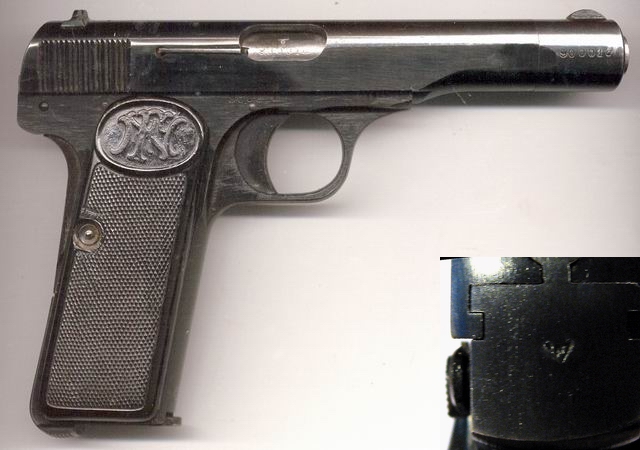
Thanks for the reply and image. You have what is known as a commercial FN Model 1922. At the time your pistol was manufactured, which was probably Feb-March of 1944, the Model 1922 was issued to military forces and would carry military markings. Your pistol is devoid of the military waffenamt on the frame and slide but carries the proof stamp eagle/N. The other mark that most (all?) commercial sales carry is the triangle punch on the rear of the frame. It is estimated that less than 10% of the sales were marked like yours for commercial sale.
Pick a model from the left hand menu. Mar 24, 2011 - FN Model 1910/22 Serial Number Curios and Relics. 1922 as the Pistole 626(b) and had them made only in 7.65mm Browning (.32 ACP).
This makes the value higher if the buyer is aware of this fact. But many are not. Unfortunately yours was polished down to bare metal maybe in preparation for a reblue at some point years ago. The value is quite diminished by this condition and perhaps it is worth $175 to $250.
If you had the holster and the G.I. Bring-back papers the value could be higher for the collector ($350-$450 depending). Calman v5 keygen serial. Thanks for the images, Dan. MK, I'll begin with the last question first.
The serial suffix is the letter 'b'. As you probably know early in wartime production there was no suffix up to serials of about 220,000 then the Germans used 'a' followed by the 'b' then ending in 'C' almost midway into that series. The finish of nickel was available but is rarely seen on prewar 1910 or 1922 and not at all during the German occupation. The FN facilities just did not cater to the nickel finish as it had little practical military or police use nor did the Germans use it.
Million Dollar Baby. The Bridge (TV Movie 2015). Molly and Ryan can't forget the best time of their lives together at The Bridge. Director: Mike Rohl. Bridge tv baby time klipi torrent. Baby Nursery Rhymes Collection by ChuChu TV S1 • E20 ChuChu TV Baby Shark - Good Habits and Many More Videos| Popular Nursery Rhymes Collection ChuChu TV Nursery Rhymes & Kids Songs.
What I see on your pistol (and the devil is always in the details) is the late war blue finish which was a thin blue applied over a rough metal surface. The blue finish remains in many corners and hard to reach locations such as just above and behind the trigger or above the trigger at the trigger pin and in many other deep metal rough lines. Have a close look at that trigger pin which, on nickel pistols, was left black but yours is polished white and the surrounding area still shows the dark blue. This is a key point or clue on your pistol. There would be no dark area around that pin on a nickel pistol. And I've never seen a magazine with just the base plate 'plated'.
I've seen nickel followers or partially dipped bodies but not one side or bottom as you have. This was an easy polishing location done to visually match the rest of the pistol.
Easy to access and easy to polish. It is striking but done for looks and not finished in nickel or chrome, in my opinion.
In 1923, the Yugoslavian authorities contracted the Belgian concern of Fabrique Nationale to develop a semi-automatic pistol firing from an eight-round magazine and sporting a 114mm long barrel for accuracy. FN took to reworking their existing Browning Model 1910 (also FN Mle 1910) and lengthening the barrel as such and increased its magazine capacity from seven rounds to eight, extending the pistol grip as a result. The end-product was nothing more than a dimensionally different Model 1910 to suit the Yugoslavian requirement, featuring a longer slide and equally lengthened grip handle. The remaining features of the Model 1910 were left largely intact including the solid trigger facility, ribbed slide sides and iron front and rear sights. The Model 1922 relied on a striker based firing mechanism through the blowback principle and was fitted with a grip safety at the grip rear spine. The weapon was designated as the 'Browning Model 1922' but would also become known by the name of 'Browning Model 1910/1922'. The pistol appeared in two distinct forms chambered for the 9x17mm Browning Short (.380 ACP) cartridge and the 7.65x17SR Browning (.32 ACP) cartridge.